
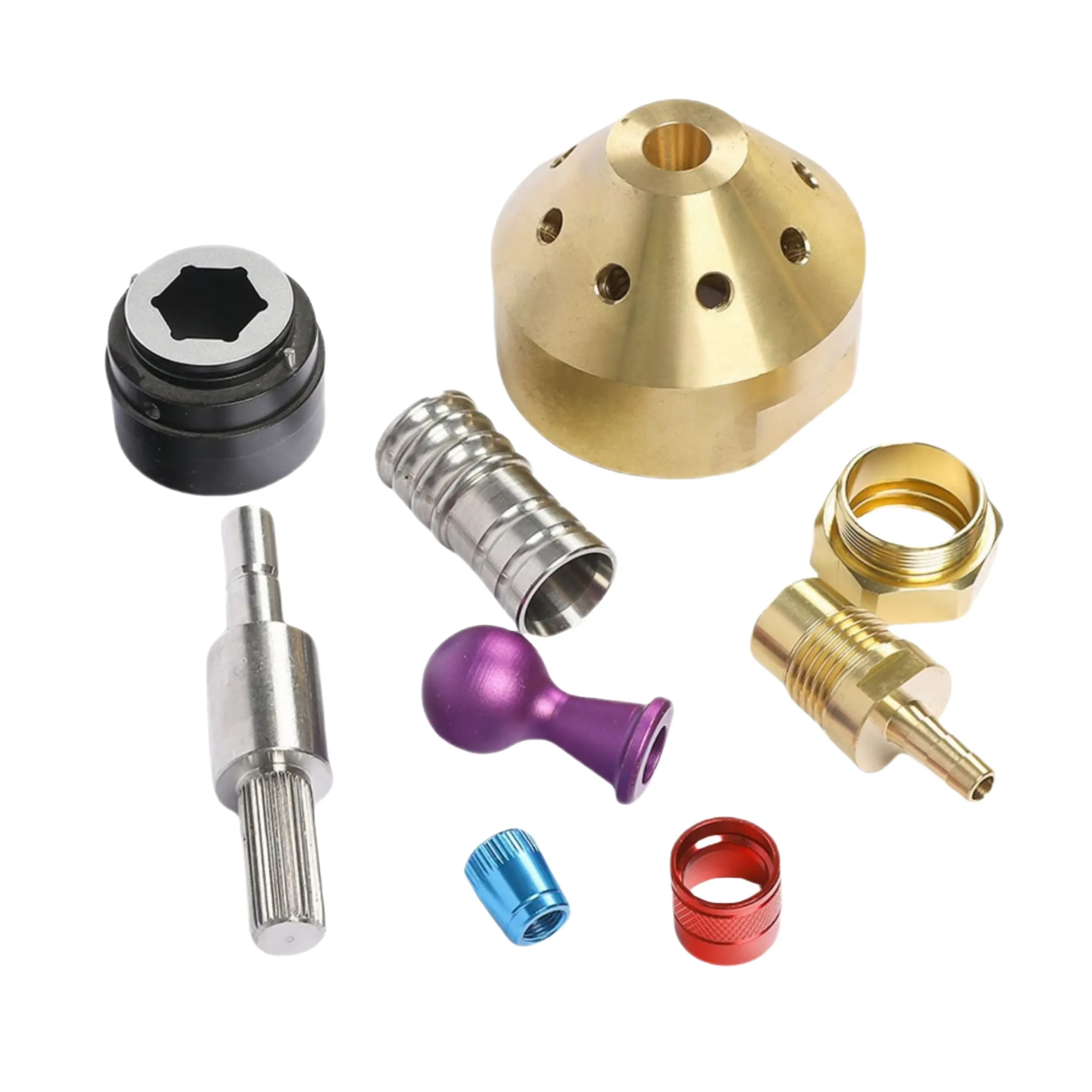
In the CNC machining industry, we often hear customers ask: “Why do some parts deform and break after a few months using the same drawings and materials, while others can serve for years in harsh environments?” The answer often lies in a seemingly i…
In the CNC machining industry, we often hear customers ask: “Why do some parts deform and break after a few months using the same drawings and materials, while others can serve for years in harsh environments?” The answer often lies in a seemingly insignificant yet crucial step—heat treatment.
If CNC machining gives a part its precise “skeleton” and “shape,” then heat treatment is the magic that gives it its “soul” and “fighting power.” It doesn’t change the part’s size and shape, but it fundamentally alters the internal structure of the metal, giving ordinary metals superior properties such as high strength, high hardness, high wear resistance, and high toughness.
I. What is Metal Heat Treatment?
Metal heat treatment is a process that alters the internal crystal structure of a metal material through an ordered process of heating, holding, and cooling in a solid state, thereby obtaining the desired mechanical properties.
To put it figuratively: the atoms inside a metal are like a group of soldiers arranged in a disorderly manner, and heat treatment is like a rigorous military training exercise. By using different “training methods” (heating temperature, holding time, cooling rate), we can arrange these soldiers into different formations. Some formations excel at defense (high hardness), some at charging (high toughness), and some are well-rounded in both offense and defense (excellent overall performance).
II. Seven Commonly Used Heat Treatment Processes in CNC Machining
1. Annealing: The “Relaxation Massage” of Metals
Core Purpose: Reduce hardness, eliminate internal stress, improve machinability, refine grain size. Process: Slowly heat the part above the critical temperature, hold it for a sufficient time, and then slowly cool it in the furnace.
Typical Applications:Stress relief treatment for castings, forgings, and welded parts
Pre-softening of high-hardness materials to facilitate subsequent CNC machining
For example: A hard stainless steel bar directly machined using CNC turning would be very wasteful of tools and result in poor surface roughness. After annealing, the hardness drops from HB280 to HB180, machining efficiency can increase by more than 30%, and tool life is greatly extended.
2. Normalizing: A more “efficient” pretreatment than annealing
Core purpose: Refines grains, homogenizes microstructure, and improves machinability
Process: Heating to above the critical temperature, holding at that temperature, and then cooling in air.
Differences from annealing: Faster cooling rate, finer microstructure, slightly higher hardness and strength than annealing, shorter production cycle, and lower cost. Typical applications: Pre-heat treatment of low-carbon and medium-carbon steel parts, and final heat treatment of ordinary structural parts.
3. Quenching: A key step in “hardening” metal
Core purpose: Significantly improves the hardness and wear resistance of parts.
Process: Heating to above the critical temperature, holding at that temperature, and then rapidly cooling (water cooling, oil cooling, air cooling).
Precautions: Quenching generates significant internal stress, making parts prone to deformation or even cracking. Therefore, tempering must be performed immediately after quenching.
4. Tempering: A “stable agent” after quenching
Core purpose: Eliminates quenching internal stress, reduces brittleness, and adjusts hardness and toughness.
Process: Heating the quenched parts to below the critical temperature, holding at that temperature, and then cooling. Based on different tempering temperatures, tempering is divided into three categories:
Low-temperature tempering (150-250℃): Maintains high hardness and wear resistance, reduces internal stress and brittleness.
Applications: Cutting tools, molds, bearings, carburized parts
Medium-temperature tempering (350-500℃): Obtains higher elasticity and yield strength.
Applications: Springs, clockwork, forging dies
High-temperature tempering (500-650℃): Obtains comprehensive mechanical properties with good strength, plasticity, and toughness.
Applications: Shafts, gears, bolts, and other important structural parts
5. Quenching and tempering: The golden combination of “quenching + high-temperature tempering”
Core purpose: To obtain excellent comprehensive mechanical properties (both strong and tough). This is one of the most commonly used heat treatment processes in CNC machining, and most important mechanical parts require quenching and tempering.
Typical Applications:Shafts, gears, connecting rods, and bolts made of medium carbon steels and medium carbon alloy steels such as 45 steel, 40Cr, and 42CrMo.
The hardness of tempered parts is generally between HRC20-35, possessing sufficient strength, good toughness, and machinability.
6. Carburizing: The Perfect Solution for “Hard Surface, Tough Core”
Core Purpose: To improve the surface hardness and wear resistance of parts while maintaining the toughness of the core.
Process: Low carbon steel parts are placed in a carburizing medium and heated to 900-950℃, allowing carbon atoms to penetrate into the surface of the parts. Then, quenching and low-temperature tempering are performed.
Typical Applications:Gears, shafts, pins, cams, and other parts requiring surface wear resistance and the ability to withstand impact loads.
The carburized layer depth is generally 0.5-2mm, with a surface hardness of HRC58-64 and a core hardness of HRC20-30.
7. Nitriding: A more advanced surface hardening process than carburizing
Core Purpose: To achieve extremely high surface hardness, wear resistance, corrosion resistance, and fatigue strength.
Process: The parts are immersed in a nitrogen-containing medium and heated to 500-580℃, allowing nitrogen atoms to penetrate the surface of the parts.
Advantages of Nitriding:
Low processing temperature, minimal part deformation, particularly suitable for precision parts
· Higher surface hardness (HV1000-1200, equivalent to HRC69-72)
· Good corrosion resistance, no further surface treatment required
· Fatigue strength increased by more than 30%
Typical Applications: Precision spindles, lead screws, molds, valves, and other high-precision, high-requirement parts
III. Five Common Misconceptions and Quality Problems in Heat Treatment
1. Misconception: The higher the hardness, the better
Many customers believe that the harder the parts, the better, but this is not the case. Excessive hardness increases the brittleness of parts, making them prone to breakage. For example, if shaft parts are too hard, they will suddenly break under impact loads instead of undergoing plastic deformation first, which is very dangerous in many situations.
2. Misconception: All parts require heat treatment.
For parts subjected to minimal stress and serving only a connecting or supporting function, such as ordinary bolts, washers, and brackets, heat treatment is unnecessary and would only increase costs unnecessarily.
3. Common Problems: Deformation and Cracking
These are the most common problems encountered during heat treatment. The main causes are excessively rapid heating and cooling rates, unreasonable part structure design, and internal material defects. Solutions include optimizing the heat treatment process, improving the part structure (avoiding sharp corners and abrupt changes in wall thickness), and selecting appropriate materials.
4. Common Problems: Insufficient or Uneven Hardness
The main causes are insufficient heating temperature, insufficient holding time, insufficient cooling rate, and surface decarburization.
5. Common Problems: Oxidation and Decarburization
Without a protective atmosphere during heating, oxidation and decarburization will occur on the part surface, leading to reduced surface hardness and decreased wear resistance. For precision parts, vacuum heat treatment or protective atmosphere heat treatment should be used.
IV. Summary
Heat treatment is an indispensable core process in CNC machining, directly determining the service life and reliability of metal parts. An excellent CNC machining plant not only needs superb machining technology, but also a solid foundation in heat treatment.