
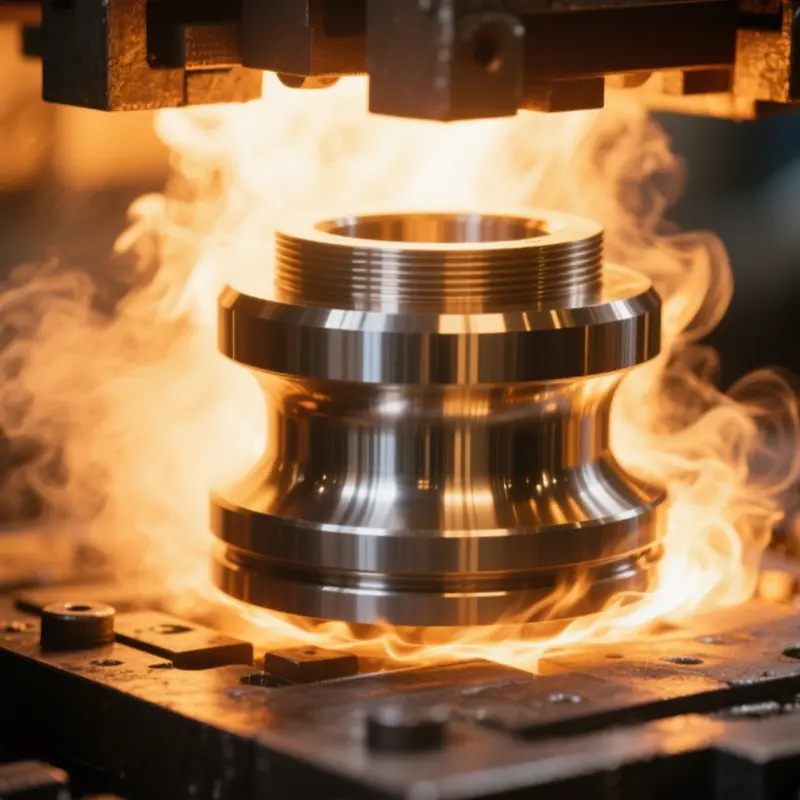
The 52100 steel heat treatment represents a critical metallurgical process that transforms high-carbon chromium steel into one of the most durable and reliable materials in modern manufacturing. This specialized heat treatment involves carefully controlled heating and cooling cycles that optimize the steel’s microstructure to achieve exceptional performance characteristics. The 52100 steel heat treatment process begins with austenitizing, where the material is heated to temperatures between 1475-1500°F, allowing carbon atoms to dissolve uniformly throughout the steel matrix. This is followed by quenching in oil or salt baths to rapidly cool the steel, creating a martensitic structure that provides maximum hardness. The final tempering stage involves reheating the quenched steel to 300-400°F, which reduces brittleness while maintaining high hardness levels typically ranging from 60-65 HRC. The main functions of 52100 steel heat treatment include enhancing wear resistance, improving fatigue life, and maximizing dimensional stability under extreme operating conditions. These technological features make the process indispensable for components requiring superior performance in high-stress environments. The treatment creates a uniform carbide distribution throughout the steel matrix, which significantly improves the material’s ability to withstand repeated loading cycles without failure. Applications for heat-treated 52100 steel span numerous industries, with bearing manufacturing being the most prominent. Ball bearings, roller bearings, and precision mechanical components rely heavily on the exceptional properties achieved through proper 52100 steel heat treatment. The aerospace industry utilizes these treated components in aircraft engines and landing gear systems, where reliability is paramount. Automotive applications include transmission components, drive shafts, and high-performance engine parts that demand exceptional durability and precision.
The 52100 steel heat treatment offers numerous compelling advantages that make it the preferred choice for demanding applications across multiple industries. First and foremost, this treatment process dramatically increases the material’s hardness, typically achieving levels between 60-65 HRC, which translates directly into superior wear resistance and extended component life. This enhanced hardness means that parts subjected to 52100 steel heat treatment can withstand abrasive conditions and maintain their dimensional accuracy far longer than untreated alternatives. The treatment also significantly improves fatigue resistance, allowing components to endure millions of loading cycles without developing cracks or failure points. This characteristic is particularly valuable in rotating machinery and bearing applications where components face constant stress variations. Another major advantage lies in the improved dimensional stability that results from the controlled heating and cooling process. The 52100 steel heat treatment eliminates internal stresses and creates a uniform microstructure that resists distortion during operation, ensuring precise tolerances are maintained throughout the component’s service life. The enhanced corrosion resistance achieved through proper heat treatment protects components in challenging environments, reducing maintenance requirements and extending replacement intervals. Manufacturing efficiency also benefits significantly from 52100 steel heat treatment, as the process can be precisely controlled and monitored to ensure consistent results across large production runs. This reliability reduces quality control costs and minimizes the risk of premature component failure in critical applications. The treatment process is also environmentally friendly when compared to alternative surface hardening methods, requiring fewer chemicals and producing minimal waste products. Cost-effectiveness represents another substantial advantage, as the initial investment in 52100 steel heat treatment pays dividends through reduced maintenance costs, longer component life, and improved overall system reliability. Companies utilizing properly heat-treated 52100 steel components often experience significant reductions in downtime and replacement costs, making the treatment an excellent long-term investment for any operation requiring high-performance materials.
Superior Hardness and Wear Resistance Through Advanced Microstructure Control
The 52100 steel heat treatment process creates an exceptional microstructure that delivers unmatched hardness and wear resistance properties essential for high-performance applications. Through precise temperature control during austenitizing, the treatment dissolves carbon uniformly throughout the steel matrix, creating an optimal foundation for subsequent hardening. The rapid quenching phase transforms the austenite into martensite, a extremely hard crystalline structure that provides the foundation for superior wear resistance. This martensitic transformation is crucial to achieving the target hardness levels of 60-65 HRC that make 52100 steel heat treatment so valuable in demanding applications. The subsequent tempering process carefully balances hardness with toughness, ensuring that components maintain their structural integrity under extreme operating conditions. This controlled hardness development translates into exceptional wear resistance that extends component life significantly compared to untreated materials. In bearing applications, for example, properly heat-treated 52100 steel can operate for millions of cycles without significant wear, reducing replacement frequency and maintenance costs. The uniform carbide distribution achieved through proper 52100 steel heat treatment creates microscopic hard particles throughout the material that resist abrasive wear while maintaining overall toughness. This combination of properties is particularly valuable in applications involving metal-to-metal contact, where surface durability directly impacts performance and reliability. The wear resistance achieved through 52100 steel heat treatment also maintains dimensional accuracy over extended operating periods, ensuring that precision components continue to function within specified tolerances throughout their service life.
Enhanced Fatigue Life and Structural Integrity for Critical Applications
The 52100 steel heat treatment process fundamentally transforms the material’s fatigue characteristics, creating components capable of withstanding millions of loading cycles without failure. This enhancement occurs through the development of a refined grain structure during the controlled heating and cooling process, which eliminates stress concentrations that typically serve as crack initiation points. The uniform microstructure achieved through proper 52100 steel heat treatment distributes applied loads more evenly throughout the component, preventing the localized stress buildups that lead to premature fatigue failure. This improved fatigue resistance is particularly crucial in rotating machinery applications where components experience constant cyclic loading. The treatment process also eliminates internal stresses that can compromise structural integrity, creating components with predictable and reliable performance characteristics. Rolling contact fatigue, a primary concern in bearing applications, is significantly reduced through the optimized microstructure achieved via 52100 steel heat treatment. The fine carbide distribution created during the treatment process acts as a barrier to crack propagation, effectively stopping small defects from growing into component-threatening failures. This enhanced fatigue life translates directly into improved system reliability and reduced maintenance requirements, particularly valuable in applications where component failure could result in costly downtime or safety concerns. The predictable fatigue characteristics of properly heat-treated 52100 steel also enable more accurate life cycle calculations, allowing engineers to optimize maintenance schedules and replacement intervals. Industries such as aerospace and automotive particularly benefit from this enhanced fatigue resistance, as it enables the development of lighter, more efficient designs without compromising safety or reliability standards.
Exceptional Dimensional Stability and Precision Maintenance Throughout Service Life
The 52100 steel heat treatment process delivers exceptional dimensional stability that ensures components maintain their critical tolerances throughout extended service periods. This stability results from the elimination of residual stresses and the creation of a uniform microstructure that resists distortion under operational loads and temperature variations. During the heat treatment process, internal stresses that develop during initial manufacturing are relieved through controlled heating cycles, preventing subsequent dimensional changes that could compromise component performance. The uniform carbide distribution achieved through proper 52100 steel heat treatment creates a stable microstructure that maintains its configuration even under extreme operating conditions. This dimensional stability is particularly crucial in precision applications such as bearing races, where even minor dimensional changes can result in increased noise, vibration, and premature wear. The thermal stability achieved through 52100 steel heat treatment also ensures that components maintain their dimensions across wide temperature ranges, making them suitable for applications involving significant thermal cycling. Manufacturing processes benefit significantly from this dimensional stability, as components can be machined to final dimensions immediately after heat treatment without concern for subsequent distortion. This eliminates the need for post-treatment machining operations, reducing manufacturing costs and improving production efficiency. The predictable dimensional behavior of heat-treated 52100 steel also enables tighter tolerances in assembly operations, improving overall system performance and reliability. Quality control processes are simplified when working with properly heat-treated components, as the dimensional stability ensures consistent part-to-part variation within acceptable limits. This reliability is particularly valuable in automated manufacturing environments where dimensional consistency is essential for proper assembly and operation.